Brent Spot Pricing and Diesel Costs: Why Physical Oil Markets Matter
- Cargo
- Economy
- Shipped
- Shipper
- Menzie Chinn
- Readers
- 399
The source identifies Brent as a physical-market price, a distinction that matters when comparing oil benchmarks with futures and fuel costs.
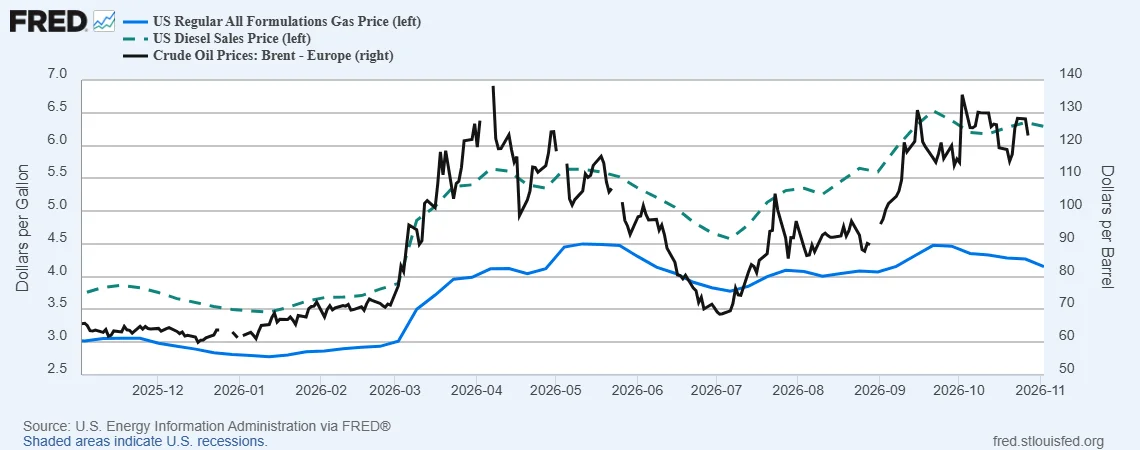
The key market detail in the discussion is that the Brent price shown by FRED refers to the spot market: a price for physical oil, rather than a futures contract. That distinction matters when readers compare oil prices across sources. A spot quote and a futures quote describe different transactions and time frames, so they can move differently without either being incorrect.
What a spot quote represents
A spot price reflects the value assigned to oil for prompt delivery under the terms of the relevant market. Brent is a widely used reference for crude oil, and its physical-market price can help describe conditions for barrels available near term. The quoted number still needs context: the delivery period, oil quality, location and pricing method all shape what a particular series measures.
A futures contract, by contrast, sets a price today for a transaction scheduled for a specified future period. Futures prices incorporate expectations and the costs or benefits of holding physical supply over time. They can therefore sit above or below spot prices. The relationship changes with market conditions; a single quote cannot explain whether current availability is tight or whether traders expect future supply to be more constrained.
That makes the commenter’s clarification about the FRED series useful, but limited. It identifies the type of price being displayed. It does not, by itself, establish the direction of the market, explain why the price changed, or show what consumers will pay for refined fuels.
Crude oil is only one part of the fuel bill
Brent is a crude-oil benchmark, while gasoline and diesel are finished products. Their prices are connected because crude is a major input, but the relationship is not one-for-one. Refining capacity, the mix of products a refinery can produce, inventories, transport costs and local distribution all affect the final price. Product supply and demand can also shift independently of crude prices.
Diesel is especially relevant to freight and commercial activity, so a change in diesel costs can affect trucking, farming, construction and other fuel-intensive operations. A truck owner deciding when to buy fuel faces the retail or wholesale price available at the relevant location, not simply the Brent spot quote. Reserving fuel in advance, as one commenter jokes about doing, would depend on the supplier’s terms, delivery timing and the price offered for that arrangement. The discussion gives no actual fuel quote or reservation terms, so it cannot establish whether such a purchase would save money.
For market readers, the practical step is to compare like with like. A crude spot series should be compared with another crude spot series on a consistent basis. A futures contract should be identified by its delivery month. Retail fuel prices should be treated as a separate measure that includes refining and distribution effects. Mixing these figures can make a market move appear larger, smaller or more immediate than it is.
Economic measures need more than one input
The discussion also raises a broader point about economic indicators: a compact measure can be informative while leaving out factors that matter to households. The misery index combines year-over-year consumer-price inflation with the U3 unemployment rate. The post cites an earlier reading of 6.8 and a current reading of 7.9, and argues that wages should also be considered because people may tolerate price increases differently when their earnings keep pace.
That is a useful measurement question, but the thread supplies no wage figures or methodology for a revised index. Its suggestion that people may weigh inflation more heavily than unemployment is presented as an uncertain recollection, not as a documented result. Without a source and clear method, it cannot support a specific weighting or a firm conclusion about how the index should change.
Any index built from a few inputs will leave out details that can shape how people experience the economy. Inflation measures changes in prices; unemployment captures a different pressure; wages can help show whether purchasing power is keeping pace. The interaction may matter too: households facing steep price increases and weak wage growth could react differently from those seeing the same inflation rate alongside rising earnings. That possibility calls for evidence and a transparent method, not a confident adjustment based on intuition alone.
What the discussion can and cannot establish
The source is a collection of comments, not a continuous market report. It offers a specific clarification about the Brent series and raises questions about fuel costs and economic measurement, but it provides no Brent price, gasoline or diesel price, wage data, or detailed comparison of oil benchmarks. Those gaps prevent a factual account of the size or cause of any recent price move.
The useful takeaway is methodological: identify whether a quoted oil figure tracks physical crude or a futures contract, then check whether the question concerns crude, refined fuel or the price paid by an end user. Each measure can tell a different part of the story. For the economic discussion, the index’s inputs and the time period behind them matter as much as its headline value. Those distinctions are what allow readers to judge a market signal without asking it to answer more than the data can show.