Dubai Fintech Summit: Talent, Digital Dirhams and Asia–Gulf Capital Flows
- Cargo
- Banking
- Shipped
- Shipper
- Mark Walker
- Readers
- 395
Dubai’s finance week put talent, cross-border wealth and digital payments in focus, while banks and merchants weighed where AI and stablecoins fit.
Dubai’s finance expansion depends on people, payments and cross-border business
Dubai Future Finance Week opened with a broad ambition: connect the city’s growing financial sector to the talent, technology and international payment routes it needs to expand. The Dubai Fintech Summit anchors the first edition of the week, which spans more than 100 events, 12 signature forums and 14 stages, with over 1,000 speakers under the theme Finance Reimagined.
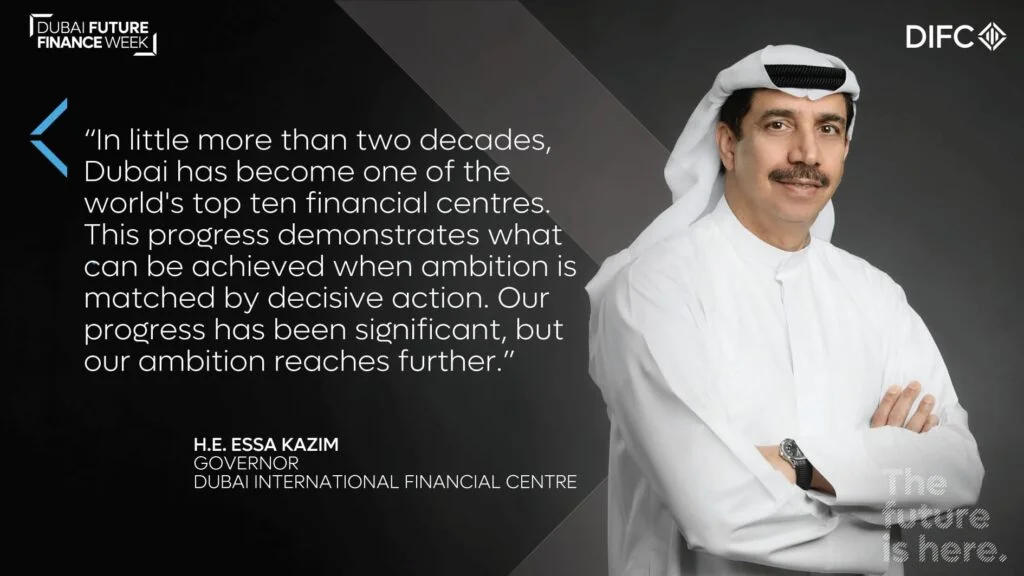
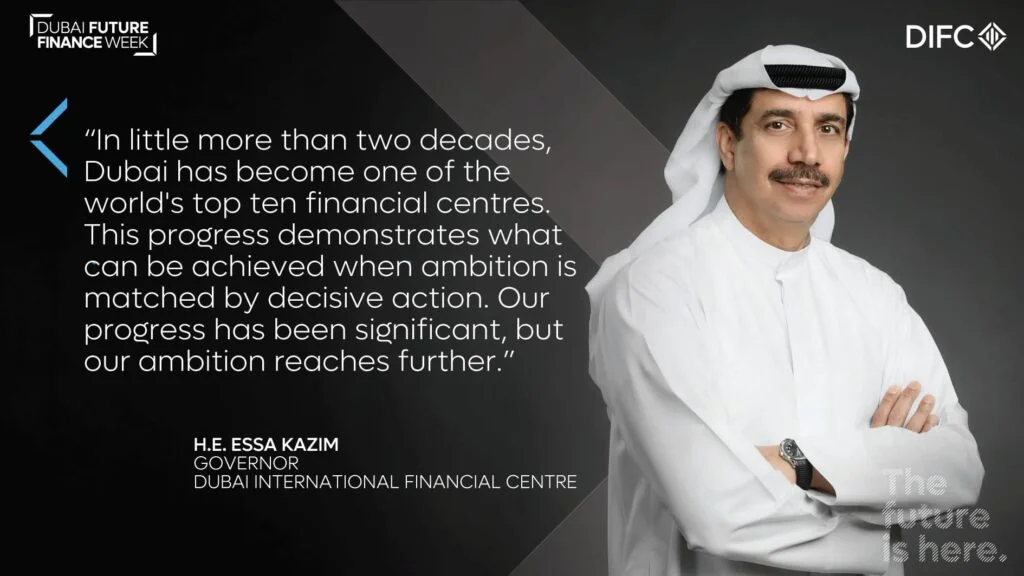
At the opening, DIFC Governor Essa Kazim cited the centre’s rise as a top 10 financial centre in little more than two decades. He also pointed to recent company growth: DIFC recorded more than 2,200 new active companies in the first nine months of 2026, 26 per cent more than a year earlier. Its AI, fintech and innovation community added close to 500 firms net over the past 12 months.
Those figures set the scene for a larger commitment to training. DIFC Academy is due to expand tenfold to 370,000 sq ft in the new Zabeel District. The planned campus will have three buildings, 54 seminar rooms, five research spaces and a graduation hall. From 2030, it will be able to accommodate more than 50,000 learners each year. For context, the academy says it has graduated 51,620 people across its first two decades.
The scale of the plan reflects a practical constraint on financial-sector growth: firms need workers who can apply new systems as well as build them. DIFC Authority chief executive Arif Amiri framed the expansion as a way to prepare people to shape finance from Dubai. The centre will also point to September’s Global Financial Centres Index, in which industry professionals ranked Dubai first globally for fintech.
Capital is moving between Singapore and Dubai
Cross-border corridors were a recurring theme in the summit programme, including a chief executives’ panel with Mambu, Network International, SC Ventures and Van Lanschot Kempen. Bank of Singapore chief executive Jason Moo made the case for closer financial links between Asia and the Middle East, describing Singapore and Dubai as places where clients seek stability and options for managing assets across regions.
Moo sees the cities as complementary hubs rather than competitors. Bank of Singapore operates from Singapore, Hong Kong and Dubai, and he described money moving in both directions: Chinese investors and senior financial-sector managers have travelled to Dubai as they consider diversification, while Gulf clients are placing assets in Asia for safekeeping and looking to ASEAN for growth. “I’m fully convinced around the Asian and the Middle Eastern corridor because I really feel like that’s where the next alliances will be built,” he said.
That movement puts weight on the connections between financial centres: the ability to serve clients across locations, move funds and support businesses as they enter new markets. The summit’s corridor discussion also included speakers from India and the UAE, reflecting the range of regional relationships in focus.
Moo offered a concrete example of AI’s operational use at his bank. Its AI agents now handle KYC work, reducing account opening from around six weeks to 15 days. But he also highlighted a risk for wealthy clients and their advisers: a family office that combines bank data in a self-built dashboard without strong cyber security can expose the wider chain. The bank is considering a client sandbox within its own firewalls, a way to give clients access to tools while keeping sensitive systems more contained.
Private banking and digital dirhams
J.P. Morgan Private Bank has opened a branch in DIFC to serve clients across the UAE and the wider region. The firm has used DIFC as its regional base for corporate and investment banking for 20 years, and it more than tripled its Dubai private banking team over the past 12 months. Selim Elgen, the UAE market head, and Karim Rekik, regional head for the Middle East, lead the team.
On digital payments, Paul Kayrouz, chief fintech officer at the Central Bank of the UAE, described two forms of dirham-based digital money with different roles. Four banks are licensed to issue dirham stablecoins, each aimed at uses such as retail payments, cross-border flows, corporate treasury or settlement between companies. The UAE introduced a comprehensive, risk-based framework for stablecoins in 2024.
Kayrouz said bank-issued stablecoins are expected to sit alongside the digital dirham, rather than compete directly with it. The digital dirham is sovereign money issued and backed by the central bank, and is intended as a settlement route between banks across borders. Stablecoins, by contrast, are aimed at retail, treasury and intercompany activity. The central bank’s stated approach is to make different payment options available and let users and businesses determine which works for each need.
The wider goal is to extend use of the dirham beyond the UAE. The central bank is working to connect trading partners in Asia, Africa, the CIS and the wider Middle East to its payment routes. The practical test will be whether these systems make payments easier and more useful for businesses and customers across borders.
AI adoption meets merchant priorities
Kayrouz also cited digital services operating under the central bank’s transformation programme: an eKYC service that cuts the time to open a bank account from around 60 days to under a day, an instant payments platform and open finance. On agentic AI, he said deployment is a matter of when rather than whether. The central bank is using its own AI agents to monitor how agents behave in the market. He argued that agentic payments need human oversight, clear consumer mandates and a fast way to reverse a transaction if something goes wrong.
The DFSA’s contribution to the discussion was a research paper produced with Cambridge’s Digital Innovation and Regulation Initiative. It examines how deployed and agentic AI could affect cyber resilience through four questions: how quickly a firm can close serious exposure, how much it depends on shared technology, whether an AI system stays within its assigned mandate, and whether the firm can establish what happened and restore critical operations. The DFSA described the paper as a contribution to research and international discussion, rather than guidance. Chief executive Mark Steward and Bryan Zhang of the Cambridge initiative were due to discuss it at the summit.
For merchants, adoption depends on immediate value. Pay10 chairman Harry Gill said the company, now live in the UAE, Bahrain and Morocco, has added a European licence this year. Stablecoin acceptance is on its roadmap for QR payments, subject to the rules allowing it, but Gill questioned whether customers with dirham accounts would soon convert funds just to buy a coffee. Pay10’s near-term focus is small merchants, with faster settlement and lower costs as the priority.
Emirates NBD is also directing attention to smaller businesses. On Monday it relaunched its National Digital Talent Incubator as NDTI AI, a programme intended to help established Emirati-owned SMEs among its customers apply AI. DIFC Innovation Hub will support its design, alongside AWS and Visa. Each cohort will include four or five businesses, with two cohorts a year; participants will develop use cases around their own operations.
The day’s announcements point to a common test for Dubai’s financial ambitions: whether new campuses, banking teams and payment infrastructure translate into practical gains for firms and customers. Talent, reliable cross-border connections and clear uses for AI and digital money will determine how much of the activity becomes durable business.


