Tokenisation’s Next Test: Liquidity, Legal Rights and Market Access
- Cargo
- Markets
- Shipped
- Shipper
- Mark Walker
- Readers
- 872
Dubai’s finance forum focused on what tokenised assets still need to scale: dependable liquidity, clear ownership rights and trusted routes to trade.
Getting tokens issued is no longer the hard part
Dubai Future Finance Week’s fourth day put a sharper question to tokenisation advocates: can digital assets become useful markets, with buyers able to sell and rights that hold up across platforms and borders? At the Future Tokenisation Forum, speakers described issuance as increasingly manageable. Liquidity, legal certainty and the cost of reaching a broad market remain harder problems.
The Dubai Financial Services Authority (DFSA) opened the discussion with a new report, Scaling Tokenisation: The Road Ahead. Chief executive Mark Steward said the paper draws on input from BlackRock, Ripple, Robinhood, Soter Insure and Standard Chartered. It considers what firms need to move from trials to financial products, payments and market infrastructure.
The report maps shared views and unresolved questions rather than selecting a technology, rulebook or business model. The DFSA says it wants the paper to prompt wider discussion among firms, investors, policymakers and international standard setters. That open approach reflects a market where the infrastructure and commercial model are still taking shape.
Connecting court decisions to digital assets
DIFC Courts offered a more specific proposal: a Dispute Resolution Oracle developed with DECA4 Advisory and industry partners. The proposed system would let parties opt in, before a transaction, to connect a smart contract with a court or another forum they select.
The problem is practical. A court may determine who owns a digital asset, yet its decision may not automatically change the asset’s record on a blockchain. Under the proposal, a disputed asset would be preserved after a claim, with the final decision then applied on chain. Judges, arbitrators or mediators would continue to hear disputes off chain. The paper describes safeguards including limited freezes, early review, reasoned decisions and appeal rights.
DIFC Courts presents the proposal as an open standard that other jurisdictions could use. Deputy director Amna Al Owais was among the forum’s speakers. Whether the system can give participants confidence will depend on how its procedures work across different legal systems and platforms.
Existing rules and new market plumbing
Regulators differed in their methods, but several speakers returned to a common principle: changing an instrument’s digital form does not necessarily change its underlying nature. Michail Fekkas, first vice chairman of Greece’s Hellenic Capital Market Commission, said tokenisation affects how an instrument is issued, transferred and traded. He argued that Europe can apply existing tools, including MiFID, CSDR, the DLT Pilot Regime and MiCA, instead of creating a separate framework for tokenised assets.
For Fekkas, the remaining barriers include uncertainty about how rules apply, fragmented markets and whether infrastructure can support itself commercially. “Europe must move from regulatory experimentation to regulatory scalability, and smaller European markets must be part of that,” he said.
William Mason, director general of the Guernsey Financial Services Commission, described a different path. Guernsey reviewed its existing laws, judged them largely fit for purpose and issued guidance on their application. Mason said the commission aims to finalise its stablecoin rules next month.
His central concern was whether holders could exit positions. Supervisors, he said, do not want private assets placed on chain and sold to retail buyers who may then struggle to sell. Automated market makers alone may not provide enough depth; active market makers taking positions would also be needed. “Buying is easy; anybody can buy,” Mason said. The market needs buyers and sellers.
Paul Kayrouz, chief fintech officer at the Central Bank of the UAE, said the central bank supervises entities and their overall balance sheets, operational resilience and conduct. A bank that tokenises securities needs a separate licence from the Capital Market Authority, while the central bank retains its broader supervisory role.
Kayrouz expects central bank digital currency, tokenised deposits and stablecoins to coexist. He said the UAE’s digital dirham is close to launch, four banks and one non-bank have been licensed to issue stablecoins, and several banks are nearing the launch of tokenised deposit programmes. The central bank’s role, he said, is to build the rails and let the market choose among forms of digital money.
For tokenised assets to move beyond closed systems, Kayrouz said, clearing and settlement will need a unified ledger. On-chain records must also carry the same legal force as the assets they represent. He raised a cross-border challenge: a small number of stablecoin issuers dominate, and their tokens circulate in the UAE despite being issued and licensed elsewhere. Consumer protection therefore depends on regulators sharing information, he said, adding that “we will never be in any stage where we will have the same regulation”.
An Israeli regulator on the panel described a related shift in the question of ownership. Control of a private key can establish who holds a token technically; financial markets also need enforceable rights, including when transactions cross borders.
Issuance costs and distribution shape the economics
A market panel argued that technology is no longer the main constraint on tokenisation. A UAE-based platform founder pointed instead to the cost of legal advice, issuing vehicles, licences and prospectuses. Those expenses can make a project difficult to justify unless an issuance reaches hundreds of millions of dollars.
At present, the founder said, much of the spending goes to lawyers, administrators and technology vendors. If tokens begin trading across multiple venues, more of the value could shift towards distribution and trading. Funds and traditional capital markets are expected to grow fastest, but tokenising an asset without a clear use case is unlikely to work. The founder also credited the UAE’s approachable regulators with helping firms find ways to meet their objectives while developing products.
A Capital Market Authority speaker said its current tokenisation framework covers securities and commodities. The authority is considering a discussion paper to assess the framework against market demand. Open questions include which assets should qualify, what disclosure should look like, who may custody tokens and whether easier access to illiquid assets should affect which buyers can acquire them. The speaker said no single adjustment would unlock the market.
Trust and liquidity stand between pilots and scale
The closing panel, moderated by BCG, compared roughly USD 3trn in crypto assets and about USD 300bn in stablecoins with USD 30bn to 40bn in tokenised real-world assets. A partner at SC Ventures, Standard Chartered’s venture arm, said current demand largely comes from crypto holders seeking exposure to traditional assets. Institutions could follow when settlement and collateral benefits improve the economics; broader participation would come later.
The partner said tokenisation alone doesn’t create liquidity. More market makers, leverage and connections between traditional and digital rails would be needed. The distinction matters for holders: a digital record can make an asset easier to represent and transfer, but it cannot ensure a buyer will be available when someone wants to sell.
Paul Boots, VARA’s senior director and head of sector development, said the authority develops its approach through pilots, including an expanding real estate tokenisation pilot with Dubai Land Department. Issuance rules are clear, and licensed broker dealers can distribute tokens. The next stage is trading across multiple platforms with market makers in place, so property token holders have a route to sell when needed.
Boots pushed back on a request to make licensing easier. He said liquidity cannot come at the expense of KYC and anti-money laundering checks, and described trusted platforms as the likely destination for buyers.
Mohamed Damak, managing director and global head of Islamic finance at S&P Global Ratings, said the firm has rated some tokenised money market funds and digital bonds at the same level as conventional equivalents after finding no added risk from the technology. He identified three obstacles: the legal structure defining what a token holder owns, interoperability between bank platforms and public blockchains, and the cash side of settlement, which still depends on banks being open.
Damak cited the DIFC Courts proposal as an example of the recourse investors may want before committing funds. Robinhood MENA’s president, whose company recently entered the UAE, said investor education remains the largest hurdle to retail demand.
Family wealth and cross-border payments
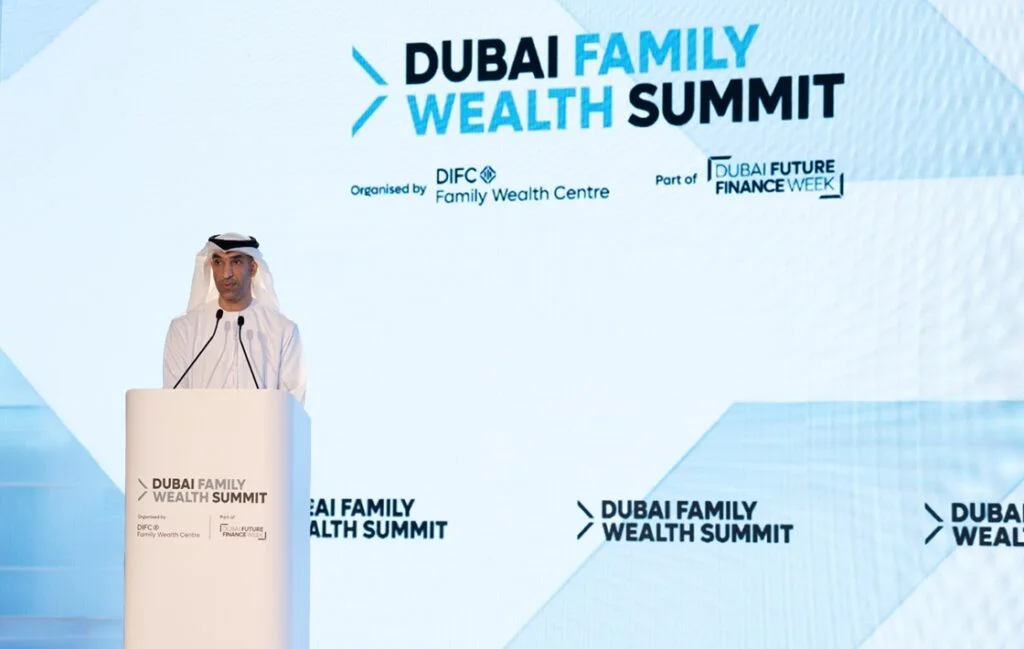
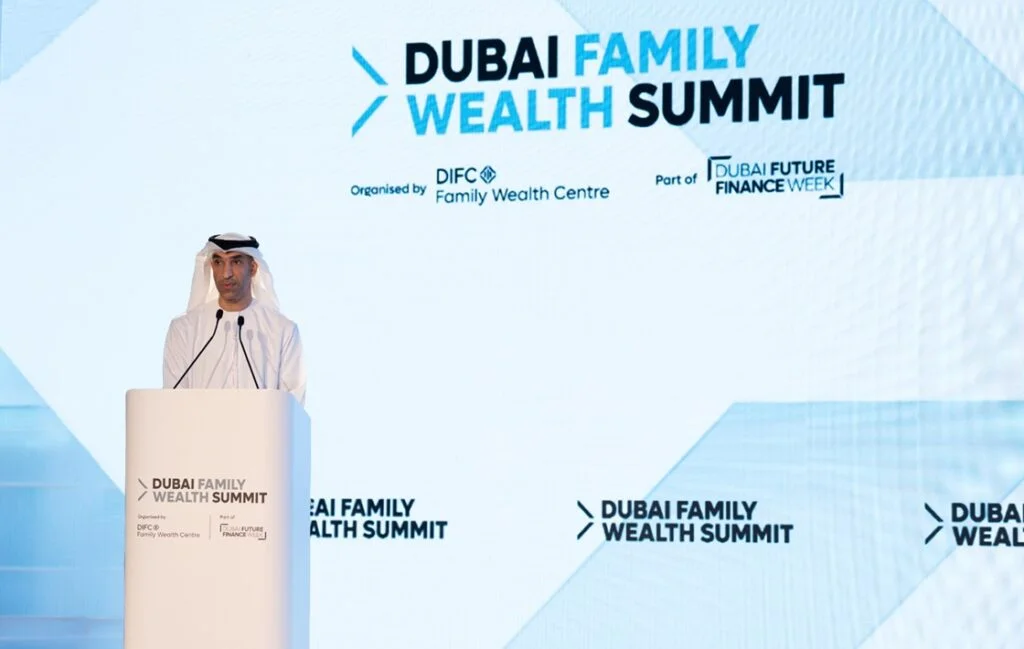
The Dubai Family Wealth Summit examined governance, succession, structuring and philanthropy, with the UAE’s Year of Family as its backdrop. Speakers included Hussain Sajwani of DAMAC, Halima Dangote of Dangote Industries, Maurice Gravier of Emirates NBD, Shehab Gargash of Gargash Prime and Osama Ibrahim Seddiqi of Seddiqi Holding. Dr Thani bin Ahmed Al Zeyoudi gave the keynote on international connectivity.
DIFC announced a 2027 NextGen Internship Programme for future family business leaders. Participants will be placed in DIFC firms across financial services, audit, consultancy, law, AI, fintech and innovation. The announcement came against an estimated USD 18.3trn global wealth transfer by 2030. The Investment Leaders Exchange brought sovereign wealth funds, institutional allocators and family offices together to discuss asset allocation and digital assets in long-term portfolios.
Outside the forums, Hong Kong-listed payments group Lianlian DigiTech opened its Middle East regional office in DIFC. It holds a DFSA Category 3D payment services licence and plans to offer cross-border collections, foreign exchange and vendor payouts for businesses trading between China, the Gulf and global markets. It already supports sellers on Noon, Amazon UAE and Amazon Saudi Arabia.
Dubai Future Finance Week concludes on Friday with GEFI’s ethical finance conference at DIFC. Across the week’s tokenisation discussions, the practical measure of progress was consistent: assets need credible ownership rights, workable settlement and enough trusted market access for holders to trade.
The post Dubai Future Finance Week day four: a tokenisation rulebook, a court on chain and the liquidity question appeared first on The Fintech Times.


