Retirement in a Downturn: Cash Buffers, Withdrawal Risk and the Case for Patience
- Cargo
- Markets
- Shipped
- Shipper
- Financial Samurai
- Readers
- 506
A downturn tests retirement plans through early losses and withdrawals. Cash reserves, flexible spending and realistic recovery timelines can help investors assess the strain.

A market downturn puts a retirement plan under pressure in a particular way: withdrawals continue even when portfolio values fall. For people whose finances can absorb that strain, however, a decline can also bring a less obvious benefit. It tests whether their plans work under tougher conditions, while giving them more freedom to spend time outside work.
The case for calm depends on the household’s finances, not on a market label. The source author describes being overweight technology stocks as individual names fell more than 20%, even though the broader market had not entered a bear market. For someone concentrated in a few volatile holdings, that distinction may offer little comfort. The central question is whether cash flow and savings can cover expenses without forcing stock sales at depressed prices.
Why a falling portfolio can affect more than investments
Rising asset values can make higher household costs feel easier to bear. When investments are gaining, a costly grocery bill, fuel purchase, tuition payment or medical expense may seem manageable against the backdrop of a growing portfolio. When account balances fall, the same expenses can feel more burdensome.
That shift can change spending. Households may postpone a vehicle purchase, travel less or eat out less often. If customers pull back, companies may face weaker sales and lower profits, which can lead them to reduce costs, including through layoffs. A job loss can then deepen the spending pullback. The source argues that an economic slowdown may become apparent to households well before it receives a formal label.
For employees who see their workplace weakening, the author suggests considering an earlier departure and links to advice on negotiating an exit package. That is a personal strategy, not a universal prescription: a worker’s options depend on their employer, role and financial position. The wider point is that market stress can reach households through both investment accounts and employment income.
Early losses can complicate retirement withdrawals
For newly retired households, the key financial risk is a poor sequence of returns: substantial losses early in retirement, while withdrawals are being made to cover living costs. Selling assets after they have fallen can leave fewer shares in the portfolio to participate if prices later recover. The longer withdrawals and losses coincide, the harder the plan may be to sustain.
That risk helps explain why retirees who rely on investments may feel more exposed than workers with regular paychecks. A paycheck can cushion a decline, and continued income can make it easier to keep saving or invest during a selloff. Retirees may have less room to replenish their accounts or buy shares at lower prices.
The author’s practical test is whether a household can get through the decline without abandoning its plan. The checklist includes holding more than one year of expenses in cash or Treasury bills, receiving meaningful income from sources such as rentals, bonds or dividends, and being able to reduce discretionary spending by 20% to 30% without a major loss of wellbeing. Another question is whether bills could still be paid if stocks fell a further 35%.

These are prompts for assessing resilience, not assurances that any given portfolio is safe. A household’s spending needs, income sources and asset mix all matter. The author also points readers to background on a withdrawal rate, income-producing investments and investing during declines.
Historical declines offer a range, not a deadline
Capital Group data cited in the source, covering the S&P 500 from 1954 through 2025, show that declines of at least 10% occurred about once every 18 months. Declines of 20% or more occurred about once every six years. On that basis, a 40-year retirement could include roughly 25 corrections and six or seven bear markets.
| Decline | How often it happens | Average length, high to low |
|---|---|---|
| 5% or more | About twice a year | 46 days (1.5 months) |
| 10% or more (correction) | About once every 18 months | 133 days (4.4 months) |
| 15% or more | About once every 3 years | 247 days (8 months) |
| 20% or more (bear market) | About once every 6 years | 402 days (13 months) |
Source: Capital Group data, S&P 500 from 1954 through 2025.
A separate count from Hartford Funds, drawing on Ned Davis Research data back to 1928, identifies 27 bear markets. In that series, stocks fell 35% on average and took 289 days to reach a low. Since 1945, the count is 15, or one about every 5.1 years.
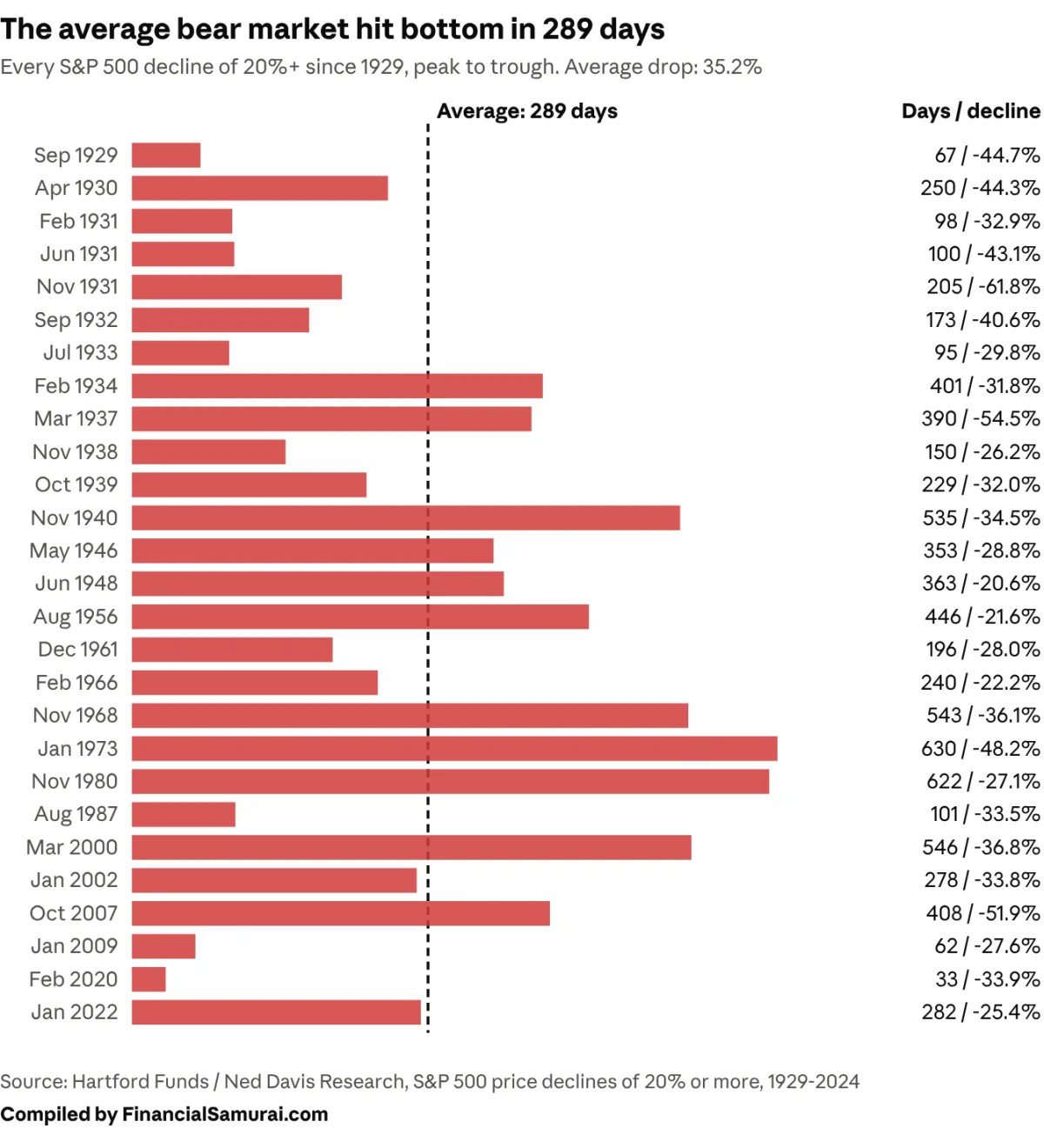
Both sets of figures measure the fall from a peak to a low. They don’t measure the full time needed to regain the previous high. And averages smooth over difficult cases: the source notes that the 1973 and 1980 declines each lasted more than 600 days. A 12-to-18-month period from peak to trough may be a planning reference, but it cannot set a reliable end date for a particular downturn.
Recovery history does not erase timing risk
The source reports that every S&P 500 correction since 1929 was followed by a recovery, and that the average return in the first year after a bottom was 52%. It also cites Hartford’s finding that about 42% of the index’s strongest days over the past 20 years occurred during bear markets.
Those figures help explain why panic selling can carry a cost: investors who leave the market may miss some of its strongest days. But historical rebounds do not tell a household when a recovery will begin, how long it will take to regain prior values, or whether a particular portfolio will track the index. Concentration, withdrawals and the need for cash all affect the outcome.
Work, spending and the value of time
The author frames work during a downturn through “Return On Effort”: how much extra work improves a person’s financial position. In roles where pay is not closely tied to performance, longer hours may have limited effect on compensation, particularly if the employer is cutting costs. A worker who takes on duties left by departing colleagues may see little or no pay increase.
That argument has limits. Work can still provide income, health coverage, a sense of purpose or a path to better opportunities. But for someone already financially independent, a market decline may sharpen the question of whether additional effort is worth the time it consumes. The author’s answer is to protect time for family and leisure, provided the portfolio can withstand the downturn.
Retirement can feel less enviable when former colleagues are receiving promotions or stock compensation during a rising market. In a decline, the comparison can flip: the person still working may be facing reorganizations and a falling value in company shares. The emotional advantage depends on circumstances, but the author’s larger point is that a market cycle changes how work and investment outcomes feel.
Potential benefits for households across the market
The article identifies several possible offsets to falling account values. Lower demand can eventually reduce prices for travel, hotels and real estate, and retirees with flexible schedules may have more room to shop outside peak periods. Those still earning may continue making contributions, buying more shares at lower prices with each paycheck. That benefit depends on stable income and a long time horizon.
Parents may also use a downturn to introduce children to long-term investing. A child has decades for compounding, though no return is assured and a fall in prices can persist. The author links to ideas for investing for children during declines.
Lower asset values may create opportunities for some tax planning. The source mentions tax-loss harvesting to offset future gains and Roth conversions at reduced valuations. The effect depends on an individual’s tax circumstances; the article offers links on Roth account strategies and workplace concerns tied to artificial intelligence.
The author also sees a possible reassurance in falling valuations for publicly traded artificial intelligence companies: if investors are reassessing what those businesses can earn, fears about rapid job displacement may prove less immediate than some expect. That is an interpretation, not a conclusion the share price alone can establish.
Finally, a downturn can expose concentration and overconfidence. The author describes having felt comfortable with a heavy technology allocation after years of gains, then finding the decline sobering. For workers, a cash reserve can also help if layoffs coincide with investment losses. Links in the source cover staying grounded after gains and preparing for market declines.
Retirement plans face a clearer test in a downturn
Retiring after a market decline can mean building a plan around lower account values, rather than around a recent peak. If the household can meet its needs with stocks down 20% or more, that stress test may reveal more about its financial margin than retiring after a long advance. But the timing alone cannot make a plan sound: income, spending, portfolio mix and the length of the downturn still matter.
By comparison, someone who leaves work near a market peak and then faces a 30% decline during the first two years of retirement meets the sequence risk described earlier. Keeping enough cash to avoid selling stocks at low prices can buy time, while flexible spending can reduce pressure on the portfolio. Neither measure removes the risk of a prolonged decline.
The useful takeaway is to judge retirement readiness against adverse conditions and to treat recovery averages as historical context, not a promise. A resilient plan can give retirees room to choose how they spend their time while markets recover. For people still working, the same period can be a prompt to review cash reserves, job exposure and the pace of regular investing.
Further reading linked in the source includes perspectives on retirement timing, effort and quality of life, market comparisons and missed opportunities, delaying a vehicle purchase, technology company performance, returning to work and fitness.
The source also offers the book Millionaire Milestones: Simple Steps To Seven Figures, plus email updates and a weekly newsletter.
Share on X · Share on Facebook · Save to Pinterest · Share on Flipboard · Share on LinkedIn
===

